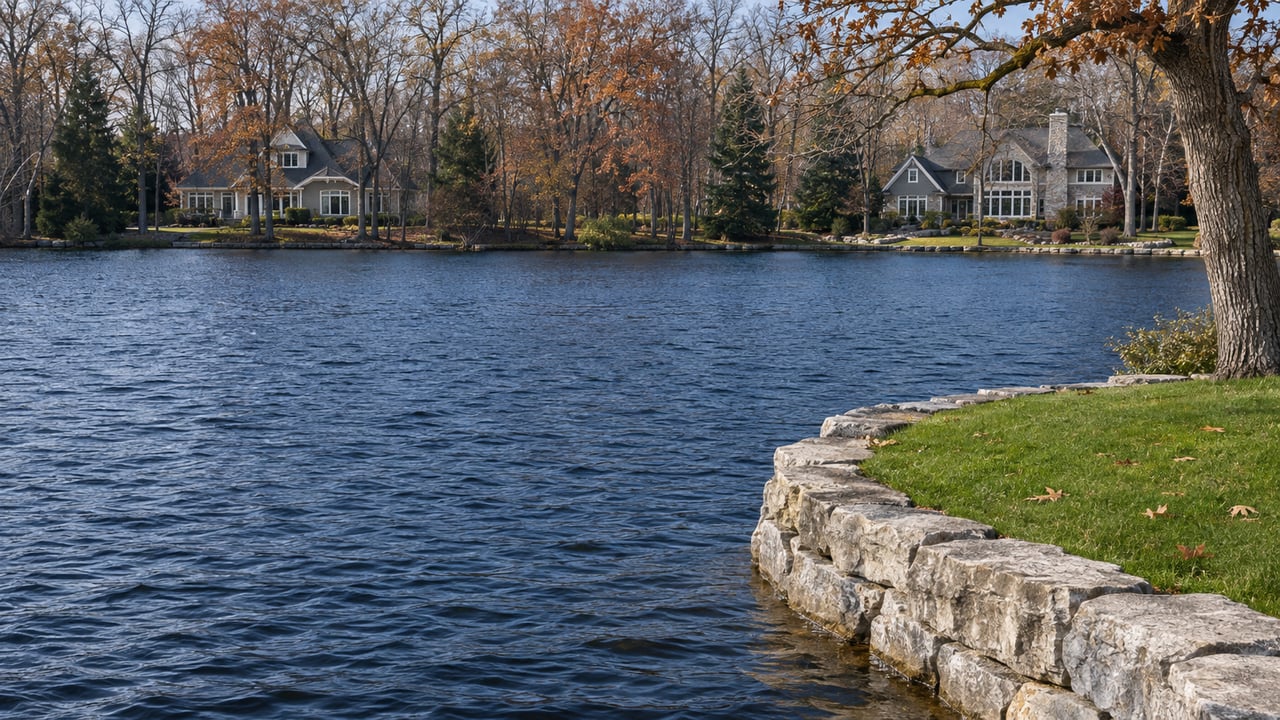
Who decides how high the water sits at the end of your dock on Lake Fenton? No lake board does, and no one turns a valve each fall. A circuit court fixed the elevation years ago, and two weirs, at Crane Road and at Swanee Beach, hold the lake to that mark. This fall the water sits well below its spring peak. Both weirs need replacing, and the first replacement goes into the county's budget before Thanksgiving. The new weirs will be set at the same court-ordered elevation as the old ones, 873 feet above sea level.
One Elevation, Written Into a Court Order
Under Michigan's Inland Lake Levels law, Part 307 of the Natural Resources and Environmental Protection Act, a circuit court sets a lake's normal level and keeps continuing jurisdiction over it. The county, through its delegated authority, maintains that level. In Genesee County, that delegated authority is the Drain Commissioner. Fenton Township's October 2021 board minutes name the Drain Commissioner as the office responsible for the weirs that control Lake Fenton's level.
In September, the Lake Fenton Property Owners Association passed along the county's position after Matt Pohlman spoke with Tom Jones, a civil engineer with the Genesee County Drain Commission. The association's September 2026 minutes put it plainly:
"Weir plate elevations will remain at the court-ordered level of 873 feet above sea level and cannot be changed without a new court order."
A weir is a fixed structure. When the lake rises above the plate, water spills over it. When the lake drops below the plate, outflow stops and the weir holds whatever water is left. That is why the readings over the past two years swing so widely while the target never changes.
Two Years of Readings at the Same Two Spots
Volunteers on the association board have been recording both weirs for years. Here are four readings, set side by side:
| When | Crane weir | Swanee Beach weir | What the board noted |
|---|---|---|---|
| November 2024 | 0.75 inch below the 873-foot set point | 1.5 inches below, sitting on a five-eighths-inch angle | Weirs flowing when they should not be |
| Easter 2026 | 14 inches above normal, water flowing into the lake | 18.5 inches above normal, slowly flowing out | Both 8 inches above the previous reading |
| August 2026 | About 4 inches above top | About 7 inches | Down 13 inches since early May, both static |
| October 2026 | 3 inches above the bottom of the weir | 5 inches above the bottom | About 13 to 13.5 inches below the April high, no movement |
The trouble at the weirs goes back to November 2024. Board chair Jim Root told the board that both weirs sat below the court-ordered elevation and were flowing when they should not be. Citizen Portal's account of that meeting ran under a headline about possible leaks. Root contacted the Drain Commission, and the board planned to take the issue back up that January.
Spring Ran the Other Way at Crane Cove
The spring problem was the reverse of the fall one. On Easter, the April 2026 minutes record water flowing into the lake at Crane Cove when it should have been flowing out. The board found three beaver dams in the Crane Cove area. Root reached Tom Jones at the county, and Jones committed to dealing with the beavers so water could leave the lake properly. At Swanee Beach, board member Matt Pohlman confirmed good outflow.
Mark Lemon posted video of the backward flow on Facebook, and it drew hundreds of views. George Dyball told the board that water-level trouble was happening statewide that spring.
From that peak, the lake dropped steadily through summer and into fall. In October, Pohlman's report counted about 1.5 inches lost since September and roughly 13 to 13.5 inches since April, with the water still and not moving at either weir.
Replacement Changes the Structures, Not the Mark
According to the September minutes, the county engineer's assessment is that both weirs need replacing. The county plans to handle them one at a time:
- Crane weir. It will be in the budget submitted before Thanksgiving. Engineering and planning follow approval, with replacement targeted for late 2026 or early 2027.
- Swanee Beach weir. It will be budgeted in 2027 and replaced about a year later.
The timeline has moved a bit as the year went on. In the July minutes, the Crane Road replacement was planned for 2027 and Swanee Beach for 2028. Thanksgiving falls on November 26 this year.
Lakefront owners will pay for the work. The September minutes say assessments will be based on linear footage of lakefront property, which matches how it has been done before. Part 307 lets a county board assign all or part of a lake-level project's cost to special assessments on benefited parcels. The delegated authority computes the costs and prepares the assessment roll. One question was still open in September. The board didn't yet know whether the assessment would fall only on riparian owners or on the broader Special Assessment District, which takes in non-lakefront properties and subdivisions south of South Long Lake Road. Pohlman agreed to follow up with Jones.
This is general information, not legal, tax or financial advice. If you have questions about how an assessment applies to your parcel, the Genesee County Drain Commissioner's office and your own advisers can answer them for your situation.
What's Showing at the Surface
The same August weed report that logged the 13-inch drop since early May also flagged surface growth. The lake is in year two of a five-year weed treatment program, and native weeds are replacing the invasives killed in year one. The minutes call the visible surface growth expected and normal. Starry stonewort has been treated wherever it was confirmed. Chara, a native lookalike, can't be treated under regulation. George Dyball reported in September that Labor Day effectively ends the lakewide treatment season.
Some shoreline owners handled their own stretch. On the Edgewater channel, Jack Topolinski hired Sandy Bottom Lake Services, a local company, to remove lily pads and rake out debris. Three neighboring households split a cost of about $1,600, and the crew cleared lily pads 8 to 10 feet into the channel. The association also reimbursed Dan Daniels for 13 E. coli water-testing sessions at $25 each, $325 in total.
The Lake Calendar Around the Weir Work
Planning for next year on the lake is already moving while the Crane weir budget step plays out:
- Grove Park no-wake sign. A buoy isn't permitted at that spot, so a no-wake sign goes up instead, with the work to be finished before spring.
- Ice-fishing tournament. The committee's tentative date is January 23, with February 20 as the backup. Both were picked to avoid clashing with the polar plunge and a Linden tournament. It returns to the Moose Lodge in a format similar to last winter's, adds a kids' category, and will need volunteers for 50/50 and raffle sales. Last winter's event drew 192 registered participants, raised almost $3,000, and paid $1,400 for first place, a 30-inch pike.
- Lights on the Lake and the boat parade. Pat O'Keefe leads both, and Lights on the Lake planning meetings start in January.
- Fireworks. The next show is scheduled for July 3, 2027, and committee meetings begin in December. As of the October 2026 treasurer's report, the fireworks savings account held about $12,500.
Shoreline footage, weir assessments and how a lake holds its level all factor into what a waterfront property is worth. If you'd like to talk through how this project affects your place on Lake Fenton, The Shane Adams Group is glad to help. Contact Us.